For information on why an SSL Certificate is required for SSL Inspection, see SSL Inspection
You may choose to install a certificate manually, as per this article:
- For testing purposes on an individual client
- If your network has a small number of iOS devices that need SSL Filtering
- If your iOS devices are not managed using an MDM solution, or Apple Configurator 2
Note: If your network has a number of iOS devices, you may prefer to deploy the certificate via your school's MDM (Mobile Device Management) solution, or Apple Configurator 2.
Prerequisite requirement: Device Certificate Issue due to TLS version Requirement
To ensure secure and reliable connectivity, all devices must use TLS version 1.2 or higher.
Devices using older versions (TLS 1.0 or 1.1) are no longer supported due to known security vulnerabilities and will be unable to connect through the network when ETI is enabled.
If your device is not compatible with TLS 1.2, you may experience connection failures or intermittent service.
What you need to do:
- Check your device or application settings and ensure TLS 1.2 (or higher) is enabled
- Upgrade end devices firmware if TLS 1.2 is not supported.
Installing an SSL or TLS Certificate (as a Trusted Root Certification Authority)
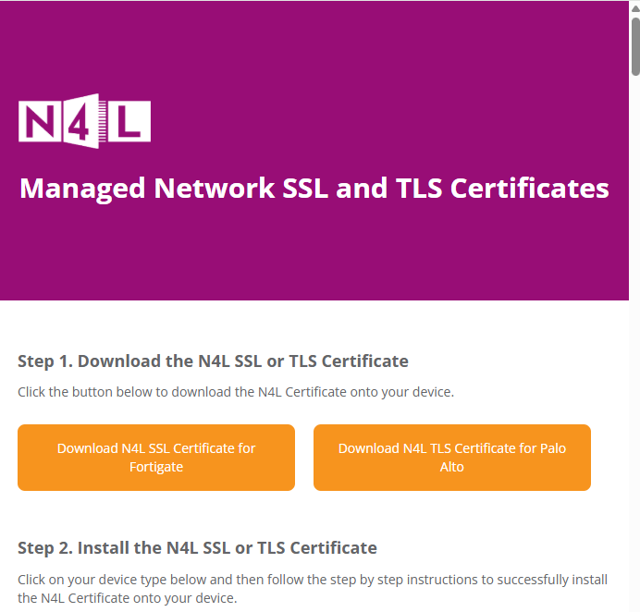
1. Access the N4L Managed Network SSL and TLS Certificates page on the iOS device.
2. Tap on the Download N4L SSL Certificate for Fortigate or Download N4L TLS Certificate for Palo Alto button.
NOTE: TLS Certificates are used for schools preparing for, or that have completed their Managed Network Upgrade (Palo Alto firewalls). SSL Certificates remain valid until migration (Fortigate firewalls).
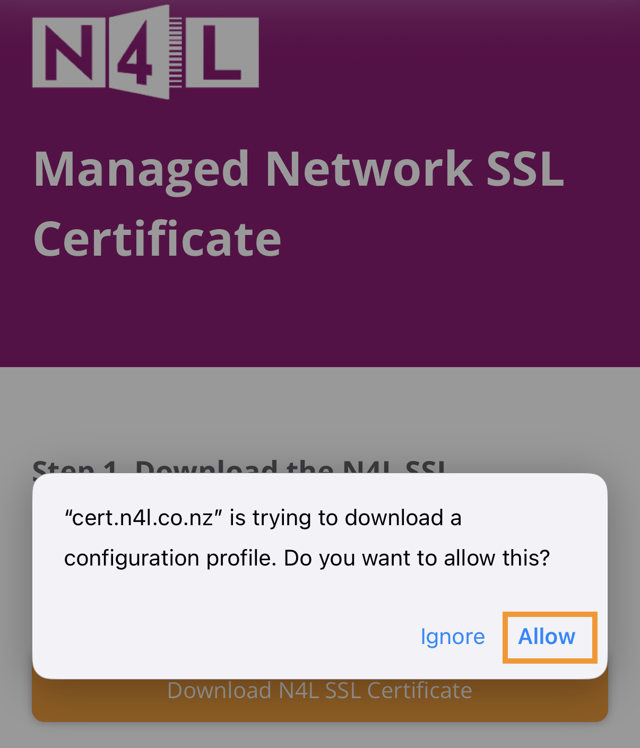
3. A pop up window will appear, tap Allow to download the certificate.
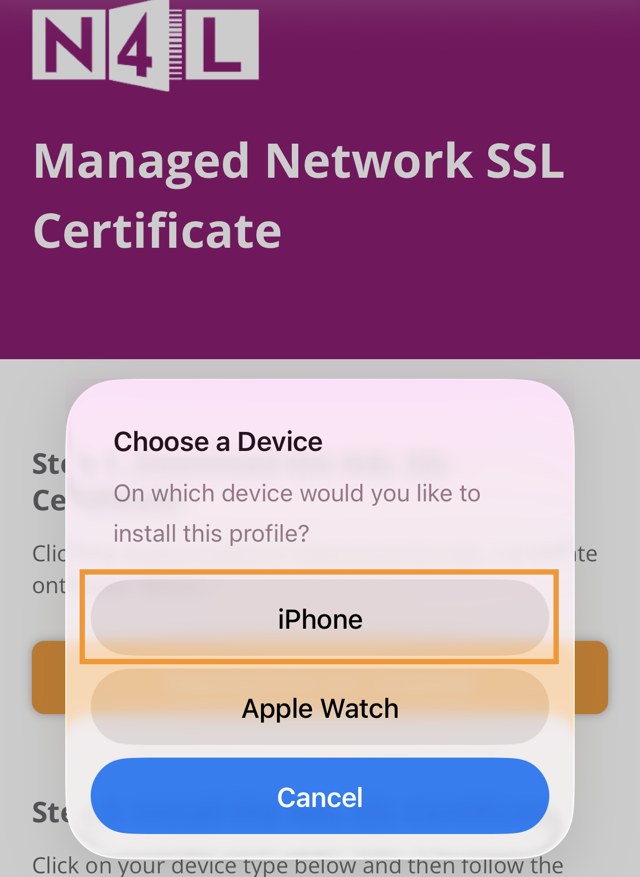
4. Choose the device type used from the pop up window. In this guide, tap iPhone.
5. Another pop up window will appear with a message: “Review the profile in the Settings app if you want to install it." Tap Close.
Next Steps: Installing the Profile
1. Open the Settings app.
2. Underneath the User details for the device, tap Profile Downloaded.
3. The Install Profile screen will be displayed. Tap Install.
4. If the iOS device has a passcode set, the device will prompt you to enter it. Enter the passcode.
5. A certificate warning will be displayed. Tap Install. If a second prompt is displayed, tap Install again.
6. The Profile Installed screen is displayed. Tap on the Check icon.
Trusting the Certificate
Before the certificate can be used as intended, it must be trusted by the device.
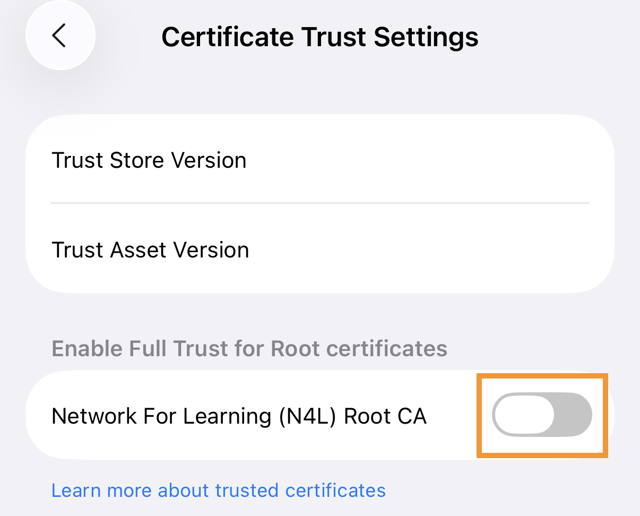
1. On the device, go to Settings > General > About > Certificate Trust Settings (at the bottom of the page).
2. The installed Root Certificate will be displayed in a section entitled "Enable Full Trust for Root Certificates." Tap the toggle button to enable the certificate.
3. A pop up window will appear, tap Continue.
When do I need to perform these steps?
Installing an SSL or TLS certificate is usually required after configuring SSL or TLS Filtering for the first time, or when the certificate has expired or been re-issued.
If you are installing certificates manually on all of your iOS devices, these steps will need to be performed on each new device that is to be subject to SSL or TLS Filtering.